

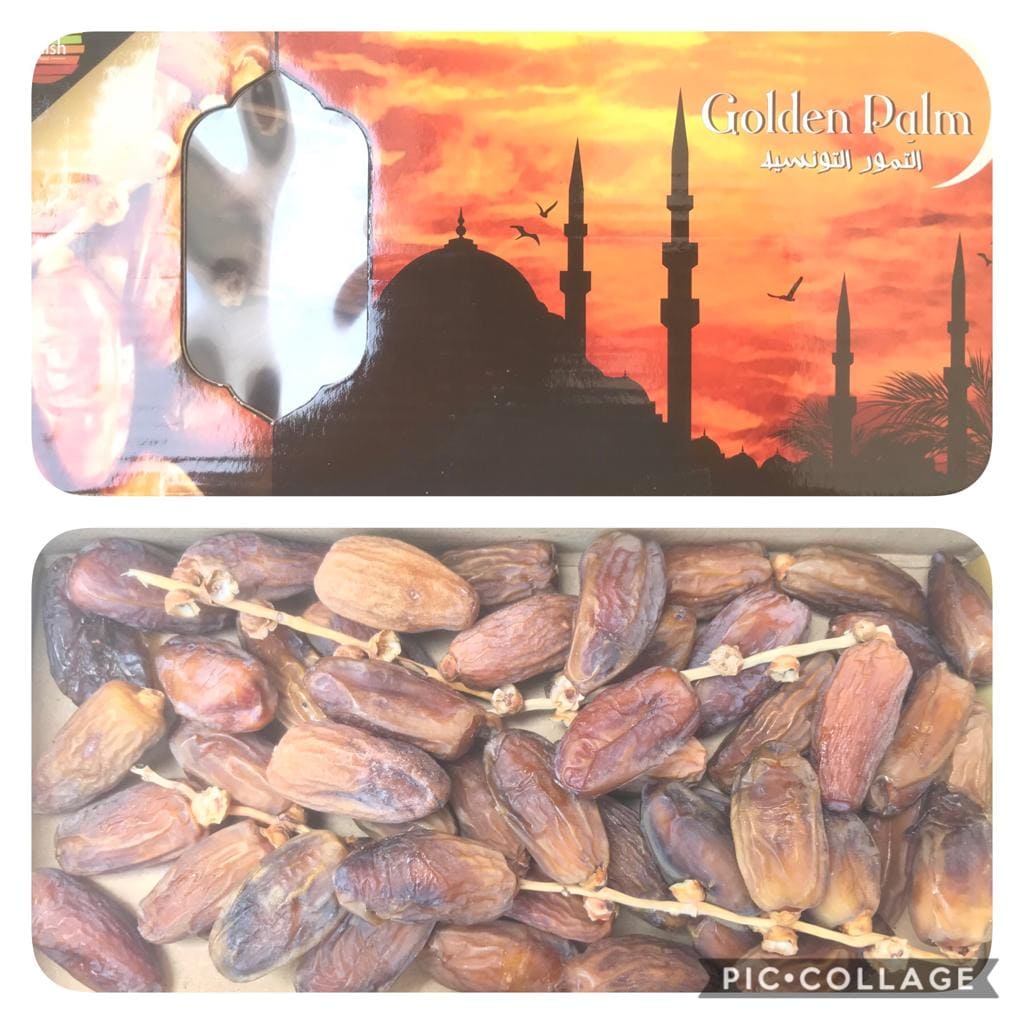
Kurma tangkai is the Malay trade name for Deglet Noor dates sold still attached to a piece of their branch. The fruit comes from Tunisia and Algeria. It is golden, translucent and semi-dry, and that short stem running through the pack is the whole reason for the name. An earlier version of this page called it a rare fruit that grows singly on the trunk. That isn't how a date palm bears fruit, and Deglet Noor is not rare: FAO's date palm handbook says it is harvested every year in tens of thousands of tons in Algeria, Israel, Tunisia and the USA.
So the "hidden gem" here is less about scarcity and more about handling. Getting a date to arrive on its branch takes a different harvest, a different packing line and more care in transport than loose fruit does. Most of that work happens on the farm and in the packing plant, the kilang kurma, long before a box reaches a Malaysian shelf. This guide walks through it using FAO's handbook (Plant Production and Protection Paper 156), then looks at what Deglet Noor packs cost in Malaysia right now.

What the "tangkai" actually is
A date palm flowers in large clusters. FAO describes each cluster as a central stem, the rachis, carrying a number of side branches called strands or spikelets, usually somewhere between 50 and 150 of them. The fruit sets along those strands. When the cluster is heavy with ripe fruit it is called a bunch.
The stem you see in a box of kurma tangkai is a cut length of one of those strands, with the dates still hanging from it. Nothing about it is special to one farm or one country. FAO says a large part of the world's Deglet Noor crop, from Tunisia, Algeria and parts of Israel, is sold this way. It also lists Deglet Noor among the long-strand varieties, the ones growers thin by cutting back the tips of the strands instead of removing whole strands from the centre.
One point worth saying plainly: the stem says nothing about Madinah. Deglet Noor is Tunisian or Algerian. Ajwa, Safawi and Mabroom are the Madinah dates.
Two ways to harvest Deglet Noor
FAO splits the Deglet Noor harvest into two quite different jobs, and which one a grower picks decides whether the fruit ends up on a branch or loose in a carton.
Harvesting on the branch
This is the kurma tangkai route. Tens of thousands of tons are harvested this way in Algeria, Tunisia and Israel, eaten at home and exported, mainly to France, Spain and Italy. The bunches are cut while the fruit is mainly at the soft rutab stage, with a few khalal dates still on them and none yet dried out. Those last yellow ones finish ripening on the way to the buyer.
The handling is fussy. Bunches are lowered carefully, often wrapped in netting against birds and pests, or in waxed paper or nylon sleeves if rain is a worry. Nobody shakes them, because shaken fruit falls off the strand. Pickers go through the grove in 3 to 5 rounds, 5 to 7 days apart, until every bunch is down. FAO repeats the warning for transport: branch fruit must not be shaken on the truck either.
Fear of rain pushes many growers to cut early, at the turn from khalal to rutab. In Tunisia the bunches are then hung in large sheds or kept in aired containers for a while so more of the fruit ripens and can be packed.
Harvesting loose fruit
The second method picks palm by palm once the fruit is at the tamar stage. FAO says every Deglet Noor in the USA is harvested this way, and other countries use it for fruit meant to be sold over a longer period. Because this fruit goes through a hydration step later, it can stay on the palm until the whole crop is equally ripe and dry. Bunches with too few dates to sell on the branch are shaken out and marketed loose too.
Inside the kilang kurma
Branch dates need their own line in the kilang kurma. FAO notes that packing for Europe was once done near Marseilles, but in recent years it happens in the countries that grow the fruit.
On arrival the fruit is fumigated, because live insects are not tolerated. Dust and sand are blown off with air pressure before the fruit is packed on its branches. Workers cut the usable branches from the hanging frames or field containers and lay them in rows along the box. Clear cellophane goes over the top, and the lid is pressed shut to keep pests out and moisture in.
The standard for this product, FAO says, was set mainly by the Tunisians and Algerians and then adopted by importers and other suppliers. The fruit should be soft and juicy, preferably light in colour with a transparent look, clean, and still attached. FAO adds that in good Deglet Noor the seed shows when you hold the fruit up to the light. The standard also sets an upper limit on moisture. The branch rules are specific:
- each branch longer than 10 cm, carrying at least 5 dates per 10 cm
- no more than 1% green fruit and no more than 1% unripe khalal fruit
- loose, detached dates no more than 3% of the box
- dry, rotten and unripe fruit picked off the branches before packing
Pack formats FAO describes
| Format | What is inside | Weight |
|---|---|---|
| Standard branch box | Branches laid in rows in a telescopic cardboard box (base and lid), usually 50 × 30 cm, sized to stack on a 120 × 100 cm pallet | 5 kg |
| Bunch box | Two whole bunches in a long cardboard box, same fruit quality as the 5 kg box | 10 kg |
| Bouquet | 3 to 5 branches tied at the base, on a small cardboard tray inside a cellophane bag; labour-intensive to pack | 200 to 400 g |
| Glove box | Dates arranged in two layers in the traditional "fish bone" pattern, with a natural or plastic spikelet on the top layer; mostly sold at Christmas, and Deglet Noor is the variety most often used | 220 to 250 g |
If you are thinking about putting dates under your own label, the packing side of that business is covered in our Malay guide to OEM dan pembungkusan semula kurma.
Why branch dates need cold storage
Here is the catch with soft, juicy fruit on a stem. FAO says Deglet Noor is sensitive and goes bad quickly, mainly by souring, so it is best kept at 0 to 4°C through packing, storage and shipping. Freezing it darkens the fruit. FAO also names Deglet Noor on branches, when packed too moist, as one of the cases where yeast starts an alcoholic fermentation and lactobacilli then sour the fruit.
There is one problem it doesn't have. Sugar crystallisation, which FAO links to moister fruit and which −18°C storage of varieties such as Medjool helps reduce, does not occur in Deglet Noor according to the same chapter.
At home the same logic applies on a small scale: keep an opened pack sealed and cool. For storage times across different dates, our piece on how long dates last sets out the figures FAO reports.
Kurma tangkai prices in Malaysia
The table below lists every Deglet Noor pack on one Malaysian wholesaler's price list, checked in November 2026. Per-kilo figures are worked out from the listed pack weight. Only one pack was in stock on the day.
| Pack (as named on the list) | Pack weight | Price | Per kg | Stock |
|---|---|---|---|---|
| Deglet Noor Bertangkai 12pkt × 400g (semi-dry) | 4.8 kg | RM88 | RM18.33 | In stock |
| Deglet Noor Bertangkai 400g × 12pkt | 4.8 kg | RM90 | RM18.75 | Out of stock |
| Kurma Deglet Bertangkai 400g × 12pkt | 4.8 kg | RM98 | RM20.42 | Out of stock |
| Deglet Bertangkai 400g × 12pkt (another brand) | 4.8 kg | RM86 | RM17.92 | Out of stock |
| Deglet Tanpa Tangkai 12pkt × 400g (promo) | 4.8 kg | RM62 | RM12.92 | Out of stock |
| Deglet Noor bertangkai 20pkt × 250g | 5 kg | RM158 | RM31.60 | Out of stock |
| Deglet Noor bertangkai 30pkt × 227g | 6.81 kg | RM188 | RM27.61 | Out of stock |
| Deglet Noor loose (bertangkai), 5kg | 5 kg | RM90 | RM18.00 | Out of stock |
| Natural Deglet Noor loose, 5kg | 5 kg | RM63 | RM12.60 | Out of stock |
| Deglet Noor 500g Tunisia A Bertangkai | not stated | RM109 | not worked out | Out of stock |
Two things stand out. First, the stem costs money. Compare the two loose 5kg packs: on the branch it works out at RM18.00 a kilo, without the branch RM12.60. Second, the 20 × 250g and 30 × 227g packs cost more per kilo than the 12 × 400g boxes. The list gives no reason for either gap. Apart from one pack with an A in its name, it sorts Deglet Noor by pack size, stem and brand rather than by A, AA or AAA grades, and those grade letters are each importer's own size sorting anyway.
For a wider look at the country these dates come from, see Kurma Tunisia and its main variety.
Using kurma tangkai
The branch is mostly about presentation. A few strands laid on a tray look different from a heap of loose dates, and FAO lists a small bouquet pack of 3 to 5 branches tied at the base. Once the fruit is off the stem it is used like any semi-dry date. FAO notes that 80% of Deglet Noor in the USA is sold without seeds, for convenience.
Demand for dates in Malaysia peaks before and during Ramadan, with Hari Raya, weddings and hantaran, kenduri and umrah gifts as the other busy periods. Since only one kurma tangkai pack was in stock on the list we checked, buyers planning for those dates may want to confirm stock early with their supplier.
Questions people ask
Is kurma tangkai a different variety from Deglet Noor?
No. It is Deglet Noor sold on the stem. The same fruit sold loose is still Deglet Noor.
Where do kurma tangkai come from?
Tunisia and Algeria. Malaysia has no commercial date-growing trade, so every date sold here, kurma tangkai included, is imported.
Does the stem prove the dates are from Madinah?
No. Deglet Noor is a North African date, and the stem tells you nothing about Madinah.
Should I keep them in the fridge?
FAO recommends 0 to 4°C for Deglet Noor in the trade because it sours quickly, and warns that freezing darkens it. A sealed pack in the fridge follows the same idea at home.